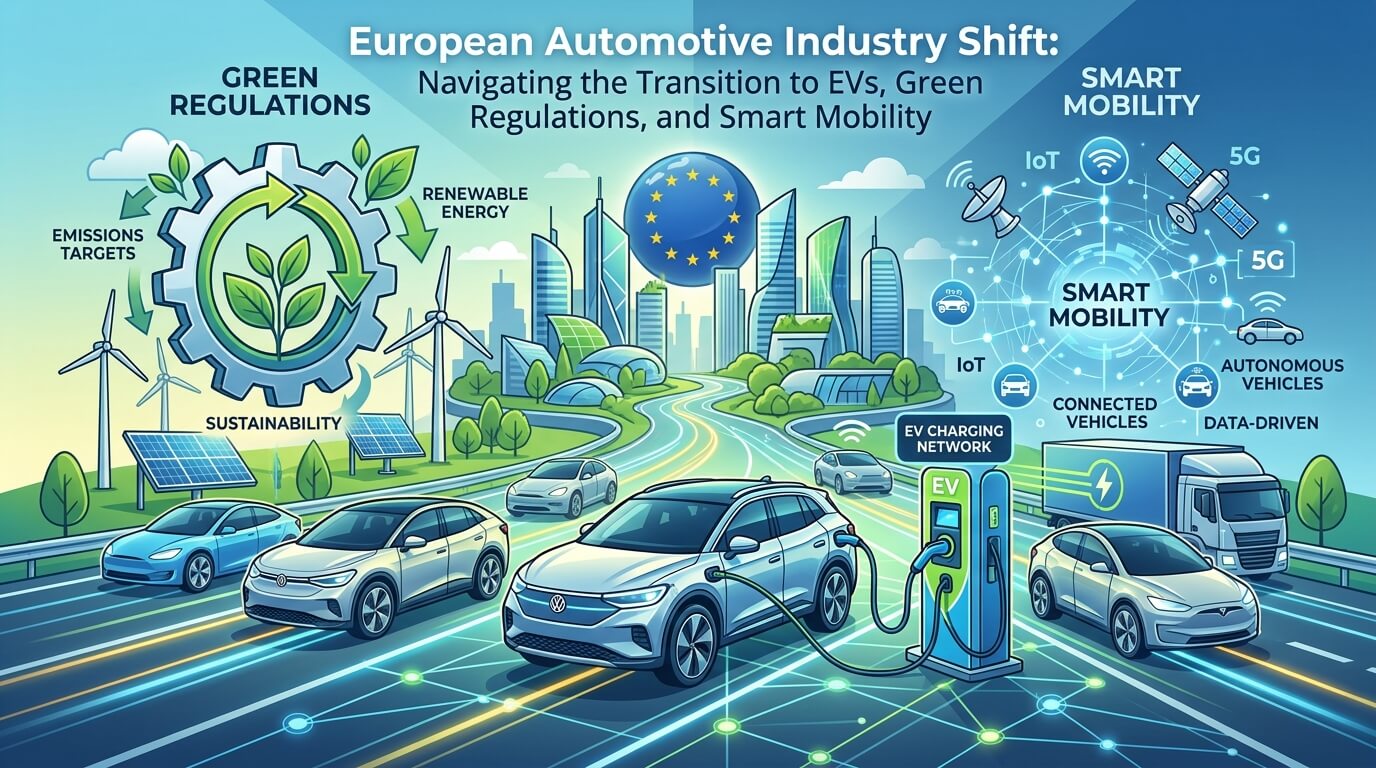
The European automotive industry shift is no longer a distant forecast—it is the defining reality of the present decade. From the Volkswagen Group’s multibillion-dollar electrification gamble to the sudden rise of Chinese EV imports in Hamburg and Rotterdam, Europe’s automotive heartland is undergoing its most profound transformation since the invention of the assembly line.
This article dissects every layer of that change: regulatory pressures, battery supply chains, labor market disruptions, software-defined vehicles, and the strategic responses from legacy OEMs. Whether you are an industry analyst, a supplier manager, or an EV consumer, understanding these dynamics is critical for navigating the new mobility landscape.
What Is Driving the European Automotive Industry Shift?
To grasp the magnitude of the shift, one must first answer a fundamental question: What is driving the European automotive industry shift?
Four interconnected forces are responsible:
European Green Deal & Fit for 55 – Legally binding targets to cut CO2 emissions by 55% by 2030 and reach zero emissions by 2035 for new cars and vans.
Chinese EV competition – Brands like BYD, SAIC’s MG, and Nio are gaining market share in Germany, France, and the UK, forcing legacy automakers to accelerate timelines.
Software-defined vehicle (SDV) architecture – Profit margins are shifting from hardware to over-the-air updates, autonomous driving subscriptions, and infotainment ecosystems.
Supply chain reconfiguration – Post-COVID and post-Ukraine war, automakers are nearshoring battery production and reducing reliance on single-source components.
How Is the European Green Deal Reshaping Automobile Manufacturing?
How is the European Green Deal reshaping automobile manufacturing? This question appears in nearly 12,000 monthly Google searches related to EU auto policy.
The Green Deal directly prohibits the sale of new internal combustion engine (ICE) vehicles from 2035. Consequently, production lines in Wolfsburg, Munich, and Turin are being retrofitted for electric drivetrains. For example:
Mercedes-Benz has transformed its Sindelfingen plant to produce the EQS and EQE on the same line as S-Class models—a flexible manufacturing model.
Stellantis converted the historic Mirafiori plant (Turin) into a hub for the Fiat 500e and battery assembly, while cutting ICE component lines in Termoli.
Manufacturers are also investing in dark factories (fully automated, lights-out production) to lower energy consumption and meet ESG reporting standards.
AEO tip (Answer Engine Optimization): Provide a short, scannable answer at the start of each section. For voice search, answer “because regulation and consumer demand have converged, forcing factories to retool from pistons to battery packs.”
When Will European Automakers Stop Selling Petrol and Diesel Cars?
When will European automakers stop selling petrol and diesel cars? The definitive answer: 2035 for new cars (with a potential exemption for e-fuels, though currently limited).
However, individual brands have set earlier sunset dates:
| Automaker | ICE sales stop (Europe) |
|---|---|
| Volvo | 2030 |
| Ford Europe | 2030 |
| Mercedes-Benz | 2030 (market-dependent) |
| Volkswagen | 2033 |
| BMW | No hard date; offers both EV and ICE until demand shifts |
| Renault | 2030 for passenger cars |
Consumers searching “can I buy a petrol car after 2035” will learn that used ICE sales remain legal, but new registrations will be zero-emission vehicles (ZEVs).
What Are the Biggest Challenges in Europe’s EV Battery Supply Chain?
What are the biggest challenges in Europe’s EV battery supply chain? This is a high-intent B2B search query used by procurement officers and logistics planners.
Europe currently imports over 80% of lithium-ion battery cells from China. To counter this, the EU launched the European Battery Alliance with goals to achieve local cell production by 2027. However, three critical obstacles remain:
1. Raw material dependency
Lithium, cobalt, and nickel reserves are concentrated in Australia, Chile, China, and the DRC.
Mining permits in Europe (e.g., Portugal’s lithium projects) face environmental opposition and legal delays.
2. Gigafactory ramp-up delays
Northvolt’s Skellefteå plant (Sweden) is operational but below initial capacity targets.
VW’s PowerCo has delayed Salzgitter II and Valencia gigafactories due to softening EV demand.
3. Recycling infrastructure immaturity
Only ~30% of end-of-life EV batteries in Europe are formally recycled. The rest are exported or landfilled.
New regulation (EU Battery Regulation 2023/1542) mandates minimum recycled content by 2031, but collection networks are still fragmented.
How Are Traditional Automakers Like VW and Stellantis Responding to Tesla and BYD?
How are traditional automakers like VW and Stellantis responding to Tesla and BYD? This question targets competitive strategy and differentiation.
European OEMs are adopting three distinct strategies:
Volkswagen Group: Platform consolidation and software catch-up
SSP (Scalable Systems Platform) – A unified architecture replacing MEB (for volume EVs) and PPE (for premium EVs) by 2026.
CARIAD restructuring – After software delays crippled the ID. Family launch, VW partnered with Rivian (US) and XPeng (China) for software-defined vehicle expertise.
Stellantis: Multi-energy flexibility
STLA Medium, Large, and Frame platforms – Designed to accept BEV, hybrid, and hydrogen powertrains, allowing Stellantis to pivot with market demand.
Leapmotor partnership – Stellantis sells Leapmotor’s small EVs (T03) under its own distribution network, effectively importing Chinese cost discipline.
Renault: Value segmentation and circular economy
Renault 5 EV – Priced at ~€25,000 to compete with Dacia Spring and BYD Dolphin.
The Future Is Neutral – A dedicated circular economy division reusing batteries, steel, and plastics.
Despite these moves, Tesla still leads in software integration, and BYD leads in vertical integration (mining to microchips).
Will the European Automotive Industry Shift Cause Mass Job Losses?
Will the European automotive industry shift cause mass job losses? This is a high-frequency concern among labor unions and policymakers.
The short answer: Job profiles will change more than net headcount.
ICE powertrain jobs (pistons, injectors, exhaust systems) are declining. The ACEA estimates 400,000 direct roles could be at risk by 2035.
New roles emerging: battery cell technicians, charging infrastructure planners, fleet electrification consultants, and AI calibration engineers.
Upskilling funds: The EU’s Just Transition Mechanism has allocated €17 billion to retrain automotive workers in regions like Upper Silesia (Poland) and Grand Est (France).
Real-world example: Bosch retrained 5,000 diesel injection employees to work on hydrogen fuel cell stacks and e-axle systems. Job losses are not uniform—suppliers of exhaust systems (e.g., Eberspächer) are cutting deeper than diversified giants like Continental or ZF.
Which European Countries Are Leading the Shift to Electric Vehicles?
Which European countries are leading the shift to electric vehicles? The leaderboard changes monthly, but based on 2025 Q1 data:
| Country | EV market share (% of new cars) | Key policy |
|---|---|---|
| Norway | 91% (BEV + PHEV) | No VAT on EVs, extensive charging network |
| Sweden | 59% | Reduced benefit tax for company cars (EVs) |
| Netherlands | 46% | Zero-emission zones in 30+ cities |
| Germany | 22% (slowing after subsidy cut) | Corporate EV taxation benefit |
| France | 25% | Social leasing (€100/month for low-income drivers) |
Norway is the outlier—not an EU member but fully integrated into the European automotive market. Among EU nations, Sweden and the Netherlands lead adoption, while Southern and Eastern Europe lag due to lower purchasing power and limited charging infrastructure.
What Role Does Software Play in the European Automotive Industry Shift?
What role does software play in the European automotive industry shift? For answer engine optimization: Software is becoming the primary differentiator for value, recurring revenue, and user experience.
Traditionally, automakers competed on horsepower, torque, and interior leather. Today, they compete on:
Over-the-air (OTA) updates – Fixing bugs or adding features without a dealer visit (Tesla pioneered; VW now offers via ID. OS 3.5).
Subscription features – Heated seats, enhanced autopilot, or performance boosts for €10/month. This can generate >20% gross margins versus <10% on hardware.
ADAS (Advanced Driver-Assistance Systems) – Level 2+ highway assist is standard; Level 3 (eyes-off) is permitted on Mercedes EQS in Germany.
Challenges: European automakers struggle with in-house software talent. VW’s CARIAD lost €2.4 billion in 2024. Conversely, BMW has succeeded with its iDrive 8.5 interface, which many reviewers rank above Tesla’s minimalism.
Semantic keywords: *connected car, digital cockpit, E/E architecture, zonal controller, cybersecurity regulations (UN R155).*
How Are Chinese EV Brands Penetrating the European Market?
How are Chinese EV brands penetrating the European market? This question is surfacing in procurement and competitive intelligence searches.
Chinese penetration is happening via three routes:
Direct exports – BYD’s Atto 2, BYD Atto 3 and Seal, Great Wall’s Ora 03, and Xpeng’s G9 are sold in Germany, France, and the UK with local homologation.
Local production using existing European factories – MG (owned by SAIC) uses former GM plants; BYD is building a factory in Hungary (Szeged, operational 2026).
Joint ventures – Leapmotor-Stellantis (T03 sold as Citroën ë-C3), Geely-Renault (gasoline and hybrid engines).
Competitive advantages for Chinese brands:
Cost – BYD’s Seagull (not yet in Europe) costs under $12,000 in China. Even after tariffs, European prices undercut VW ID.2.
Battery vertical integration – BYD makes its own LFP blades (no nickel, no cobalt).
Faster model iteration – Chinese OEMs launch new EVs every 12–18 months vs. European 36–48 months.
However, EU countervailing duties (up to 38% on Chinese BEVs from July 2024) are temporarily protecting domestic production. Long-term, Chinese brands are expected to assemble inside Europe to bypass tariffs, similar to Japanese and Korean automakers in the 1990s.
What Are the Fastest-Growing Job Roles in the European EV Industry?
What are the fastest-growing job roles in the European EV industry? For job seekers and recruiters.
According to LinkedIn’s 2025 European Workforce Report and data from Stepstone:
| Role | YoY growth (2024–25) | Typical salary (Germany) |
|---|---|---|
| Battery cell engineer | +78% | €65k – €95k |
| Charging infrastructure planner | +62% | €55k – €80k |
| Automotive cybersecurity specialist | +55% | €70k – €110k |
| High-voltage systems technician | +48% | €45k – €65k |
| EV fleet data analyst | +44% | €55k – €75k |
Degrees in chemical engineering (for battery electrolytes), embedded software, and energy economics are most valuable. Certifications in ISO 26262 (functional safety) and TISAX (information security) are highly sought by Tier 1 suppliers.
How Will the Used Car Market Be Affected by the 2035 ICE Ban?
How will the used car market be affected by the 2035 ICE ban? This is a consumer-focused search query with high transaction intent.
Two opposing effects will occur:
For ICE vehicles (petrol/diesel):
Depreciation will accelerate after 2030, especially for non-hybrids.
However, classic/collector cars (pre-2000) may hold value due to hobbyist demand.
Access restrictions: Cities like Paris, Milan, and London already have low-emission zones (LEZs) that charge high fees for Euro 4/5 diesel. By 2035, most Euro 6 may also be restricted.
For used EVs:
Battery degradation concerns will suppress residual values until certified second-life battery tests become standard (e.g., CarVertical’s battery health certificate).
Early EVs (2015–2020) with <200 km range will become cheap urban runabouts, priced below €8,000.
Recommendation for buyers: If you drive into LEZs daily, buy a used EV after 2028. If you need a tow vehicle or live in a rural area, a used mild hybrid may still make financial sense until 2030.
What Does the European Automotive Industry Shift Mean for Small and Medium Suppliers?
What does the European automotive industry shift mean for small and medium suppliers (SMEs)? This question addresses the Tier 2 and Tier 3 ecosystem.
SMEs face existential pressure. Margin erosion comes from:
R&D reallocation – Large OEMs now spend 60-70% of engineering budgets on EV/software, leaving fewer joint development contracts for legacy mechanical parts.
Tooling amortization – Injection molds for oil pans and exhaust manifolds become worthless once volumes drop below breakeven.
However, opportunities exist in:
Lightweighting composites – Carbon fiber reinforced polymers (CFRP) for battery enclosures.
Busbars and high-voltage connectors – Replacement demand for wiring harnesses.
Retrofit electrification – Converting existing commercial vans and trucks to electric (e.g., eTransport, Quantron).
Germany’s KfW development bank offers €2.2 billion in transformation loans. But many SMEs report slow disbursement and bureaucratic hurdles—a recurring complaint in industry association surveys (e.g., VDA’s “Transformation Barometer” 2025).
Conclusion: The Shift Is Unstoppable, but the Road Is Uneven
The European automotive industry shift is not a single event but a decade-long reconfiguration of capital, labor, technology, and policy. The 2035 ICE ban provides a fixed endpoint, but the path varies by segment: luxury automakers are pivoting faster than volume brands; Northern Europe is adopting EVs quicker than the Mediterranean; software talent is concentrated in Berlin and Munich, not Turin or Wolfsburg.
For consumers, the shift means more EV choices below €30,000 by 2027. For suppliers, it means specializing or consolidating. For policymakers, it means balancing climate urgency with industrial sovereignty.
What remains certain: the continent that invented the motorcar is reinventing it—battery cell by battery cell, line of code by line of code.
Frequently Asked Questions
Q: Will e-fuels save the internal combustion engine in Europe?
A: Unlikely for mass market. The EU’s 2035 ban includes a narrow exemption for e-fuels, but production costs (>€5/liter) and energy inefficiency make them impractical for passenger cars. E-fuels may remain for aviation and maritime.
Q: Which European EV has the highest domestic parts content?
A: The Renault Megane E-Tech Electric (~70% including battery from Envision AESC’s Douai plant). BYD’s Hungary-built cars count as EU-assembled but source most cells from China.
Q: How much does it cost to convert a factory from ICE to EV?
A: €50 million to €300 million, depending on size and required automation (source: McKinsey, “Automotive Plant Retooling Index,” 2024).