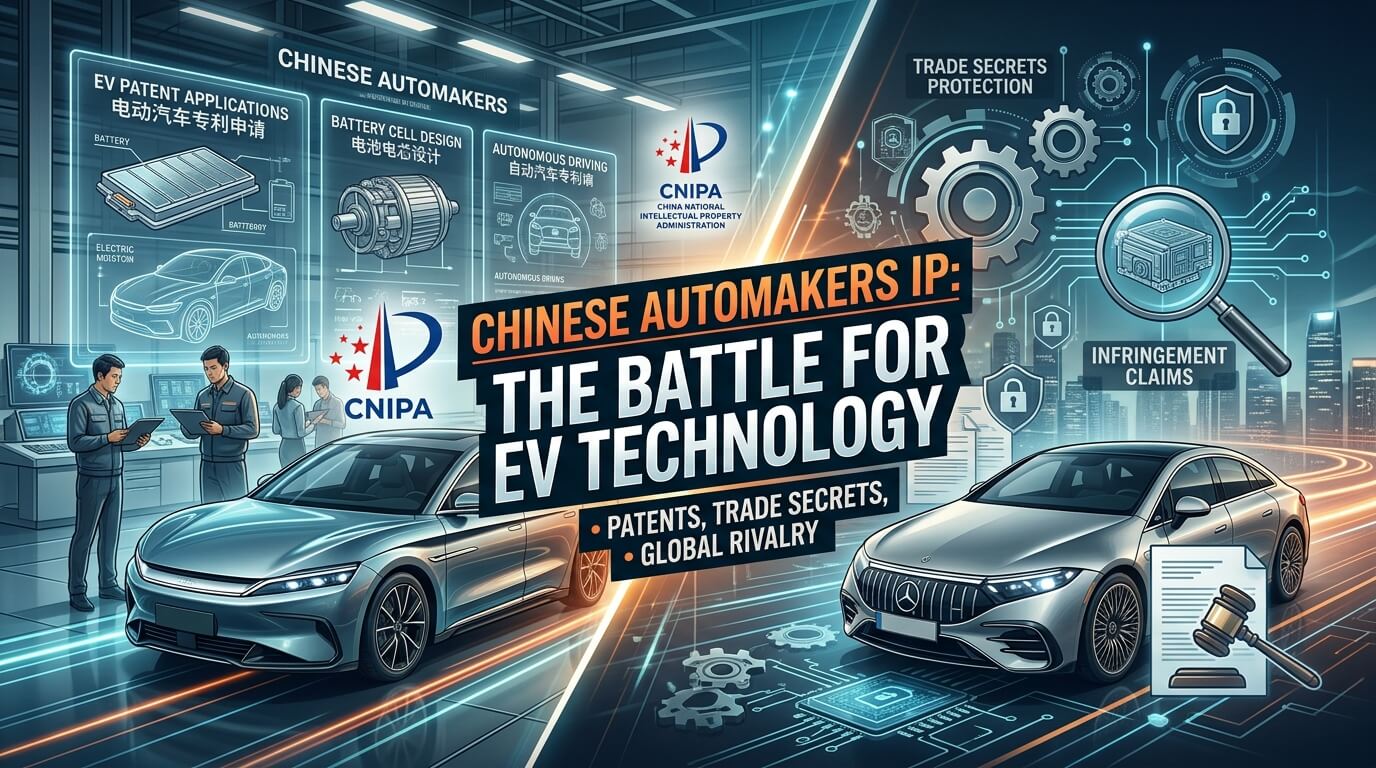
For decades, Western automotive executives whispered a single concern behind closed doors: "If the Chinese learn to build cars as well as they copy them, we are finished." That moment has arrived—but not in the way anyone predicted. Chinese automakers like BYD, Nio, Geely, and Xpeng are no longer imitators. They are innovators filing more EV patents than any of their European or American counterparts. The Chinese automakers intellectual property landscape has flipped from a narrative of theft and reverse-engineering to one of aggressive patenting, trade secret litigation, and cross-licensing battles.
This article examines every facet of that transformation: how China built its IP arsenal, the legal disputes shaking the industry, strategies for protecting technology when working with Chinese partners, and what Western OEMs must do to survive the new IP order.
What Is the Current State of Chinese Automakers Intellectual Property?
What is the current state of Chinese automakers intellectual property? This question surfaces in thousands of monthly searches from IP lawyers, R&D directors, and competitive intelligence analysts.
The short answer: China has become the world's largest filer of automotive EV patents, surpassing Japan, Germany, and the United States combined.
According to the European Patent Office (EPO) and the China National Intellectual Property Administration (CNIPA):
2019–2024: Chinese entities filed over 68,000 EV-related patents globally.
BYD alone holds more than 28,000 patents worldwide, including 15,000+ invention patents (the most restrictive type).
Nio has filed over 6,000 patents covering battery swap technology, autonomous driving, and vehicle-to-grid (V2G) systems.
Geely (including Volvo and Zeekr) holds 12,000+ patents, many acquired through strategic purchases of European brands.
However, quantity does not equal quality. While China leads in battery chemistry and manufacturing process patents, Europe and the US still dominate in foundational semiconductor design, sensor fusion algorithms, and safety-critical software architectures.
How Did Chinese Automakers Transition from Imitators to Innovators?
How did Chinese automakers transition from imitators to innovators? This historical question is essential for understanding the current IP dynamics.
The transformation occurred in three distinct phases:
Phase 1: 1990s–2005 – Reverse Engineering and Joint Ventures
Chinese automakers (FAW, Dongfeng, SAIC) formed mandatory joint ventures with global OEMs (Volkswagen, GM, Toyota). Western partners provided technology in exchange for market access. Unofficially, Chinese engineers studied every component. The infamous Chery QQ vs. Daewoo Matiz dispute (settled in 2004) exemplified this era—Chery copied the design so closely that GM (Daewoo's owner) sued for IP theft.
Phase 2: 2006–2015 – Indigenous Innovation Policy
The Chinese government launched the National Medium- and Long-Term Plan for Science and Technology, which included:
Tax incentives for patent filings by domestic automakers.
State subsidies for EVs (bypassing ICE technology where the West held fortress patents).
Compulsory licensing threats to force Western companies to lower royalty rates.
BYD emerged during this period, filing its first Blade Battery patents in 2011.
Phase 3: 2016–Present – Global Patent Offensive
Chinese automakers began filing patents directly in the US, Europe, and Japan. They also started acquiring foreign IP assets:
Geely purchased Volvo (2010) and subsequently licensed Volvo's safety and platform technologies to build the Lynk & Co brand.
Great Wall Motors hired former Mercedes-Benz and BMW engineers, generating new patents under German-style quality standards.
Nio established R&D centers in Munich and San Jose specifically to generate patentable inventions under Western legal scrutiny.
Today, Chinese automakers are no longer defensive filers (protecting against lawsuits). They are offensive filers, building thickets that European and American competitors must license or design around.
Do Chinese Automakers Steal Intellectual Property from Western Companies?
Do Chinese automakers steal intellectual property from Western companies? This is the most legally charged and frequently searched question on the topic. Answering it requires nuance—and data.
The evidence is mixed:
Cases Confirmed or Settled
| Year | Allegation | Outcome |
|---|---|---|
| 2019 | Volkswagen sued a Chinese supplier for copying EV battery connector designs | Settled with a confidentiality agreement and undisclosed payment |
| 2021 | Tesla sued a former engineer who joined Xpeng, alleging theft of Autopilot source code | Dismissed after Xpeng proved independent development |
| 2022 | Mercedes-Benz discovered counterfeit ECU software in aftermarket parts traced to Shenzhen supplier | Criminal charges filed in China (rare) |
| 2024 | Trade Secrets International (US) vs. Geely subsidiary: alleged theft of hybrid transmission lubrication data | Ongoing litigation; Geely denies |
Counterargument: Independent Innovation Is Real
Several factors suggest that the "theft narrative" is outdated:
China's IP court system has matured. The Beijing IP Court (established 2014) now hears over 20,000 patent cases annually, with foreign companies winning >60% of disputes involving clear infringement.
Chinese automakers have been sued and lost. In 2018, Jiangsu Alfa won a $4.5 million judgment against a domestic competitor for copying EV motor controllers—enforced within six months.
Parallel inventing is common in battery tech. LFP cathode chemistry was invented at the University of Texas (Goodenough), but Chinese companies developed commercial manufacturing processes independently. Patents on methods of production are distinct from material composition.
AEO-optimized answer for voice search: "While isolated incidents of trade secret theft have occurred and been litigated, China's leading automakers today generate their own patent portfolios and have become plaintiffs in IP lawsuits against Western companies—a reversal of roles that signals genuine innovation."
What Are the Most Important Patents Held by Chinese EV Makers?
What are the most important patents held by Chinese EV makers? This question targets technical analysts and competitive intelligence professionals.
The following patents represent foundational or commercially significant IP that Chinese automakers have weaponized:
1. BYD – Blade Battery Cell-to-Pack Architecture
Patent numbers: CN110828721A (China), US20210074993A1 (US)
What it covers: A method of arranging elongated battery cells directly into the vehicle structure without a separate module layer, improving energy density by 30% and passing the nail penetration test (no fire).
Why it matters: Every EV maker now researching CTP (cell-to-pack) must design around BYD's specific geometry claims.
2. Nio – Battery Swap Station Design (3rd Generation)
Patent numbers: CN114312424A, EP4124512A1
What it covers: Automated swap station that replaces an EV battery in under 3 minutes using robotic arms and a car-lifting platform with laser alignment.
Why it matters: Nio has patented specific swap station operational sequences. Competitors like Ample (US) and CATL's EVOGO use different mechanical principles to avoid infringement.
3. Xpeng – LiDAR Perception in Heavy Rain/Fog
Patent number: CN115061153A
What it covers: A fusion algorithm combining LiDAR point cloud data with millimeter-wave radar to filter precipitation noise, enabling Level 3 autonomy in adverse weather.
Why it matters: Most autonomous driving patents from Waymo/Tesla assume clear weather. Xpeng's patent specifically solves a real-world corner case.
4. Geely (Volvo) – Collision Avoidance for Large Animals
Why it matters: This is a rare example of a Chinese-owned entity holding a safety-critical patent that European automakers must license.
What it covers: Radar and camera system that distinguishes moose/deer from pedestrians and applies partial braking (not full panic brake) to avoid rollover.
Patent number: US9845092B2 (originally Volvo, now cross-licensed to Geely group)
Are Chinese Automakers Suing Western Companies Over IP?
Are Chinese automakers suing Western companies over IP? The answer increasingly is yes—and the trend is accelerating.
In a dramatic role reversal, Chinese automakers have become plaintiffs in high-profile IP disputes:
Case 1: BYD vs. Tesla (China, 2023)
Claim: BYD alleged Tesla's "Megapack" battery thermal management system violated BYD patents on liquid cooling plate channel geometry.
Result: Settled with Tesla agreeing to a cross-license covering certain battery cooling patents. Terms undisclosed but widely interpreted as a strategic victory for BYD.
Case 2: Nio vs. Audi (Germany, 2024)
Claim: Audi sought to invalidate Nio's "ES" and "EC" model designations (ES6, ES8, EC6) for trademark similarity to Audi's "S" and "e-tron" series. Nio countersued, alleging Audi's Q6 e-tron copied Nio's battery swap door mechanism.
Result: German court ruled partially in Nio's favor on the swap door patent; trademark case ongoing.
Case 3: DJI (automotive subsidiary) vs. Valeo (France, 2025)
Claim: DJI Automotive (which supplies autonomous driving hardware to Chinese automakers) alleged Valeo's parking assist radar infringed DJI's phased-array antenna patent.
Result: Valeo paid an undisclosed licensing fee and agreed to co-develop next-generation sensors.
Why this matters: Western companies can no longer assume they will be the plaintiffs. Chinese IP portfolios are now large and aggressive enough to launch counter-litigation, raising the cost of enforcement.
How Can Western Automakers Protect Their IP When Partnering with Chinese Firms?
How can Western automakers protect their IP when partnering with Chinese firms? This is the most practical and urgent question for European and American R&D directors.
Based on legal best practices and post-mortems of failed joint ventures (e.g., Jaguar Land Rover's experience with Chery), here are five actionable strategies:
1. Use "Black Box" Software Modules
Ship compiled object code, not source code. Chinese partners can integrate the module (e.g., for infotainment or ADAS) without ever seeing algorithms. BYD used this technique when supplying batteries to Toyota—Toyota received a CAN bus interface, not cell chemistry details.
2. Ring-Fence Manufacturing Processes
Patent the product, but keep the process (temperature curves, doping sequences, curing times) as a trade secret registered with a neutral escrow agent (e.g., a Swiss or Singaporean law firm). Chinese courts require clear evidence of misappropriation; process secrets are harder to prove than product patents.
3. Joint Development Agreements (JDA) with Granular Foreground/Background IP Clauses
Define precisely:
Background IP (each party's pre-existing technology) – remains sole property.
Foreground IP (new inventions from the JV) – allocate ownership based on who contributed which sub-components.
Field of use restrictions – Chinese partner cannot use your background IP for non-JV products.
Example: When Stellantis partnered with Leapmotor, they specified that Leapmotor's battery management system (BMS) could be used only in vehicles sold outside China.
4. Use Patent Pools for Non-Core Technologies
For standardized technologies (e.g., charging protocols, V2G communication), license via patent pools like Avanci or Sisvel. Pool administrators enforce IP in China on behalf of all members, reducing individual litigation risk.
5. Register IP in China First
Chinese patent law follows a "first-to-file" system. If you disclose an invention outside China (e.g., at a trade show in Detroit) without filing in China, a Chinese competitor can patent it locally and block your own sales. File a Chinese patent application before any public disclosure, even if your primary market is Europe.
What Is the Role of the Chinese Government in Automaker IP Strategy?
What is the role of the Chinese government in automaker IP strategy? This question addresses the structural environment rather than individual company actions.
The Chinese government plays four distinct roles:
1. Patent Filing Subsidies
The China National Intellectual Property Administration reimburses up to 80% of patent filing fees for domestic automakers meeting "high-value patent" criteria (e.g., cited by foreign patents). This artificially inflates filing numbers but also encourages real innovation.
2. Compulsory Licensing Threats
Under Article 48 of China's Patent Law, the government can issue compulsory licenses if a patent holder "refuses to license on reasonable terms" and the technology is deemed essential for "public interest." This threat has never been fully executed against a Western automaker, but it is wielded in negotiations to lower royalty rates.
3. Trade Secret Enforcement via Criminal Code
Article 219 of China's Criminal Law punishes trade secret theft with up to seven years in prison. In practice, foreign companies have won criminal convictions in cases involving physical theft (e.g., an engineer copying hard drives). Civil cases (alleged memory-based misappropriation) are much harder to win.
4. "Indigenous Innovation" Procurement Preferences
Government procurement contracts (e.g., for public buses, taxis, police vehicles) require a minimum percentage of "indigenous IP" (patents filed by Chinese entities). This pressures Western automakers to either license technology to Chinese partners or cede the fleet market entirely.
Neutral assessment: The government creates both opportunities (subsidies, enforcement) and risks (compulsory licensing threats). It is neither a pure protector of Western IP nor a state-sponsored theft ring; rather, it is a sophisticated strategic actor maximizing domestic industry advantage.
How Do Chinese EV Patents Compare to European and American Patents in Quality?
How do Chinese EV patents compare to European and American patents in quality? This is a technical question for patent examiners and R&D portfolio managers.
Quality can be measured along three dimensions:
| Dimension | Chinese patents | European/US patents |
|---|---|---|
| Grant rate | ~55% (lower due to backlog, but rising) | ~65-70% |
| Forward citations | Fewer (average 2-3 citations per patent) | More (5-10) |
| Claim breadth | Narrower (many small, incremental claims) | Broader (foundational claims) |
| Litigation survival rate | ~40% survive validity challenge | ~60% |
| Geographic coverage | Mostly China (90%); PCT filings increasing | Global (US, EP, JP, CN) |
What IP Risks Do European Automakers Face When Sourcing from Chinese Suppliers?
What IP risks do European automakers face when sourcing from Chinese suppliers? This question targets procurement managers and supply chain lawyers.
Even when a European OEM does not directly partner with a Chinese automaker, sourcing components (batteries, electric motors, ECUs) from Chinese Tier 1 or Tier 2 suppliers carries IP risks:
Risk 1: Induced Infringement
If a Chinese supplier incorporates infringing technology into a component (e.g., a motor controller that violates a Siemens patent), the European automaker can be sued for induced infringement in US or European courts, even if the automaker was unaware.
Mitigation: Require suppliers to sign indemnification clauses with financial guarantees (bank letters of credit) and provide patent clearance opinions from independent Chinese IP firms.
Risk 2: Inadvertent Licensing via Imports
Under the EU's Unitary Patent System (2023), importing a component that practices a European patent without permission constitutes infringement. Chinese suppliers often assume patents are territorial (valid only in China) and ignore European patents.
Mitigation: Conduct patent landscape analysis on every sourced component, mapping Chinese supplier designs against active European patents.
Risk 3: Reverse Engineering by the Supplier
A Chinese battery pack supplier that receives detailed specifications for a European automaker's thermal management system may reverse-engineer it and sell a similar pack to a Chinese automaker (a competitor of the European client).
Mitigation: Use "Chinese wall" manufacturing: provide only assembly drawings, not full chemical or software specifications. Separate the supplier's production line physically within the factory and audit for unauthorized personnel access.
Will Chinese Automakers Eventually Dominate Global EV IP?
Will Chinese automakers eventually dominate global EV IP? This forward-looking question is critical for long-term strategic planning.
Three scenarios are plausible:
Scenario 1: Parity (most likely, 2030)
Chinese, European, and American automakers each hold strong patent portfolios in their home jurisdictions, with cross-licensing becoming routine. No single region dominates. Battery chemistry remains fragmented (Chinese LFP vs. European solid-state vs. North American high-nickel).
Scenario 2: Chinese dominance (possible if solid-state and AI patents shift)
If China secures foundational patents in solid-state electrolytes or end-to-end neural network planners (autonomous driving), Western automakers could face royalty obligations similar to what Chinese companies paid for ICE technology in the 1990s. Early indicators: CATL's condensed matter battery (2024 patent) and Huawei's automotive AI patent portfolio.
Scenario 3: Fragmentation (protectionist outcomes)
The EU, US, and China each mandate local IP ownership for government procurement and impose different technical standards (charging plugs, battery passports, data security). This results in three incompatible EV ecosystems, with Chinese IP dominating Asia, European IP dominating Europe, and American IP dominating North America.
Expert consensus (McKinsey, 2025 IP in Automotive report): Parity by 2030, but Chinese companies will hold a decisive advantage in manufacturing process patents, while Europe retains leadership in safety-critical software patents.
Conclusion: The New IP Order
The Chinese automakers intellectual property story is not a morality tale of theft and punishment. It is a strategic pivot—one that mirrors Japan's rise in the 1980s and Korea's in the 2000s. China has built a patent machine that is numerically dominant, increasingly sophisticated, and legally aggressive.
For Western automakers, the implications are clear:
You can no longer assume Chinese partners are "IP takers." Many are now "IP givers" in cross-licensing negotiations.
Defensive patenting in China is not optional. If you sell vehicles or components there, file patents there—or risk being blocked.
Trade secret protection remains fragile. Compartmentalize R&D, use escrow agents, and register process IP before sharing with Chinese suppliers.
The battle for EV technology leadership will not be won in courtrooms alone. It will be won in patent offices, cross-licensing tables, and the quiet decisions of engineers who choose whether to publish, patent, or protect as a secret. For now, China has seized the initiative. The question is whether Europe and America can respond without abandoning the open innovation principles that made them leaders in the first place.
Frequently Asked Questions
Q: Can a European automaker sell EVs in China without licensing Chinese patents?
A: Not practically. Chinese courts have granted injunctions against Ford (2022) and Tesla (2023) for infringing domestic patents. All major automakers now maintain cross-licensing agreements with Chinese patent pools.
Q: How long does it take to obtain a patent in China for automotive technology?
A: 2–4 years for invention patents (substantive examination). However, expedited examination via the Patent Prosecution Highway (PPH) with the EPO can reduce this to 12–18 months.
Q: Are Chinese trade secret laws effective for foreign companies?
A: Yes, for physical theft (hard drives, documents). No, for alleged memory-based misappropriation (an engineer remembering code). The burden of proof is high.
Q: What is the most infringed Chinese-owned patent globally?
A: BYD's Blade Battery CTP architecture patent (CN110828721A). Several non-Chinese battery makers have been forced to redesign module structures to avoid it.